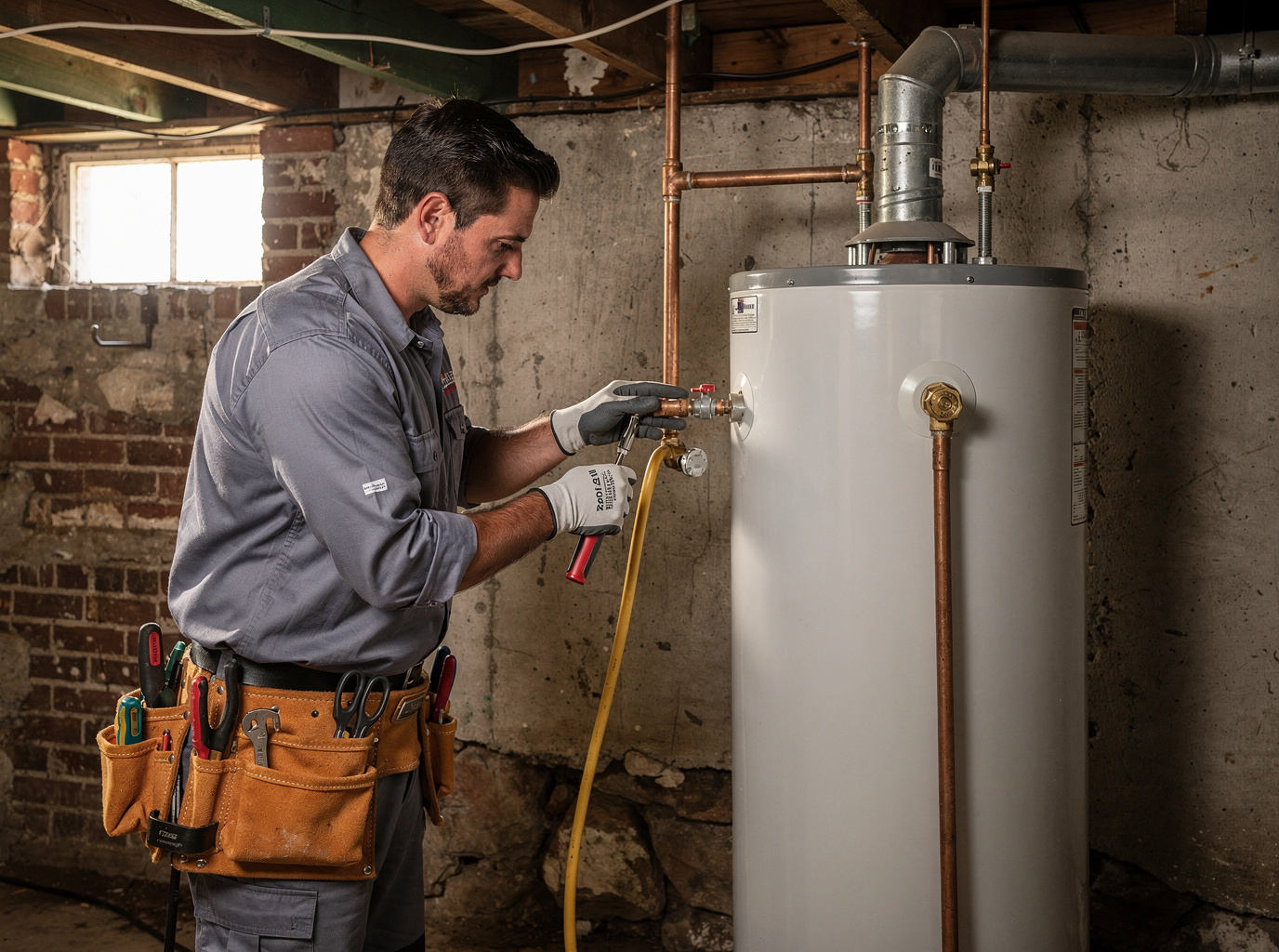
Annapolis homes built before 1970 in Historic Annapolis and Murray Hill often have narrow utility rooms and outdated venting that complicate new installations. Installers must account for the humid subtropical climate where summer humidity accelerates corrosion on exposed piping while winter temperature swings increase demand on recovery rates. Proper seismic strapping and expansion tank placement become essential when tying into older galvanized lines common in West Annapolis and Admiral Heights.
Chesapeake Bay proximity means many Eastport and Parole properties sit on fill or high water tables that affect floor-mounted tank stability and require additional anchoring. Gas line sizing must match the higher BTU loads needed during cool winters, while electric upgrades in Admiral Heights frequently involve panel assessments before adding 240-volt circuits. Code compliance with Anne Arundel County inspections includes specific venting clearances near the Maryland State House historic district boundaries.
Tankless units installed near City Dock or along the Chesapeake Bay Bridge corridor demand careful combustion air calculations because of tighter building envelopes in renovated townhomes. Condensing models require condensate drains routed away from finished spaces to avoid moisture issues during humid summers. Every installation includes a final flow test at multiple fixtures to verify pressure consistency across multi-story homes typical in these neighborhoods.
Technician insight
In Annapolis the thing that catches most people out with Water Heater Installation is discovering galvanized supply lines in Historic Annapolis and Murray Hill homes that crumble on contact, forcing an unplanned repipe before the new unit can be connected.
Eastport Waterfront Home
Homeowner needed a new tankless unit after the existing tank failed during a cool snap. Inspection revealed corroded gas piping and insufficient combustion air in the tight utility room near the water. We rerouted venting through the exterior wall, upgraded the gas line, and anchored the unit against tidal surge vibration. The system now delivers consistent hot water without pressure fluctuations.
Water Heater Installation Services We Offer
✓Tankless Water Heater Installation
On-demand units sized for Annapolis households reduce standby loss in humid summers and fit compact Eastport utility closets where space is limited.
✓Electric Water Heater Installation
Standard and hybrid electric models installed with proper circuit upgrades for Parole and West Annapolis homes that lack recent panel work.
✓Gas Water Heater Installation
Atmospheric and power-vent gas models matched to existing venting in Historic Annapolis homes while meeting current Anne Arundel County combustion air rules.
✓Hybrid Heat Pump Water Heater Installation
Energy-efficient units placed in conditioned spaces to offset high summer humidity loads common throughout Murray Hill and Admiral Heights.
✓Expansion Tank Installation
Required addition on closed systems in older Annapolis housing stock to prevent pressure spikes during winter temperature fluctuations.
Water Heater Installation Cost in Maryland
| Service | Typical Range | What Affects It |
|---|---|---|
| Standard 40-50 Gallon Tank Installation | $900–$1,600 | Varies with venting type and access in older homes |
| Tankless Water Heater Installation | $2,200–$3,800 | Depends on gas line upgrades and condensate routing |
| Hybrid Heat Pump Installation | $1,800–$2,900 | Includes electrical circuit assessment |
| Expansion Tank Add-On | $250–$450 | Required on many pre-1980 Annapolis properties |
Ranges are typical for Maryland and confirmed with an exact written quote before any work starts.
How it works
- 1
Site Assessment
Technician inspects existing connections, venting routes, and electrical or gas supply in the specific Annapolis neighborhood home.
- 2
Unit Selection and Sizing
Match capacity and fuel type to household demand while accounting for local water conditions and climate-driven recovery needs.
- 3
Removal and Prep
Safely disconnect and remove old equipment, then prepare anchoring points and piping for the new installation.
- 4
Installation and Testing
Set new unit, connect all lines, perform leak and pressure tests, then verify operation at multiple fixtures.
- 5
Final Inspection and Handover
Confirm code compliance, explain operation, and provide maintenance guidance for the local climate.
Pricing
Upfront quotes provided after on-site inspection; 24/7 availability for scheduling.